By Shayna Mace | Photo by John Maniaci, UW Health
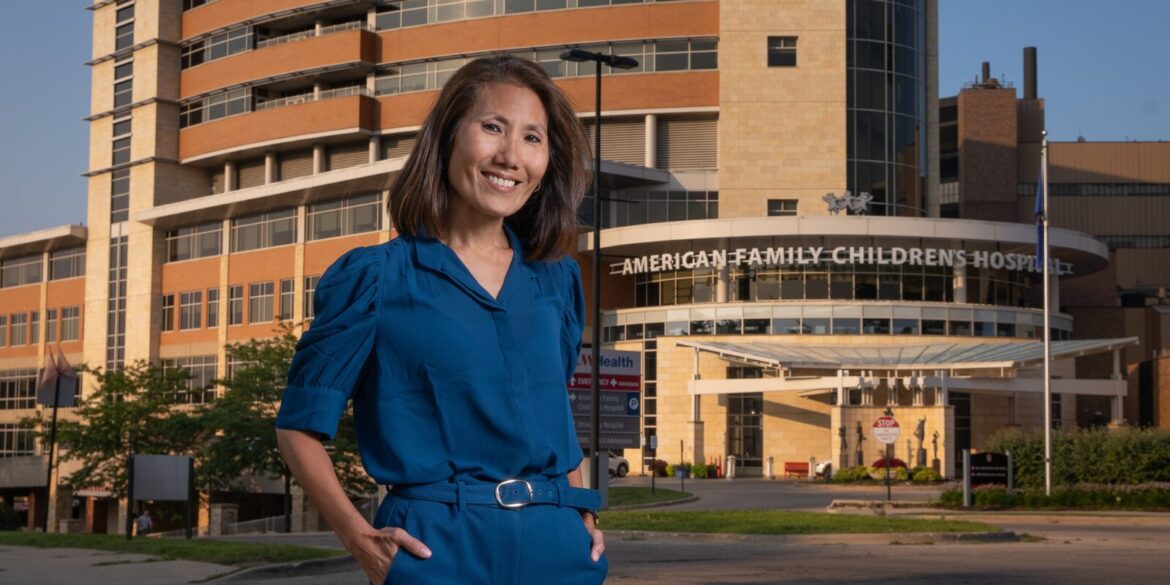
Although Nikki Stafford has a big job as president of the American Family Children’s Hospital and system VP of pediatric services at UW Health Kids, she still appreciates the little things in life — like handwritten notes.
“I think handwriting thank-you notes is a lost art, especially in this age of technology,” muses Stafford.
Stafford began her career as an occupational therapist, but decided to pursue health care administration positions after colleagues encouraged her to do so.
“In learning and developing my skills, I found myself craving more challenges, so when opportunities arose, I actively pursued them,” says Stafford.
Prior to joining UW Health in March 2020 (“right before the world changed with the onset of COVID-19,” she notes), Stafford was the operations executive at Prisma Health Children’s Hospital-Upstate in South Carolina. Concurrently, she held administrator positions for the Neurosciences Clinical Programs and Greenville Memorial Hospital at Prisma Health.
In spring 2025, Stafford announced that UW Health is planning to add 24 pediatric and cardiac intensive care beds on the empty sixth floor of the American Family Children’s Hospital. When the children’s hospital opened in 2007, the sixth floor was left vacant for future growth to meet anticipated increasing demand.
“We are ranked among the nation’s top 50 children’s hospitals … and as the [only] Level I Pediatric Trauma Center [in the region], the demand for our expertise continues to increase. Our 21-bed pediatric intensive care unit (PICU) [is] operating at capacity consistently. This shortage of intensive care beds significantly limits our ability to meet the needs of children with the most critical and complex medical cases, leading us to decline requests to transfer kids from other hospitals who require a higher level of care,” she notes.
By stepping back to assess broad challenges and prepare for what lies ahead, Stafford is helping to position the Madison region as a leader in children’s critical care. We also asked Stafford to share a few nuggets of wisdom about her life and career.
What’s one career risk you’re glad you took and why?
In business, people often believe every career move should be upward. If you make a lateral move, it’s often viewed as a demotion or a poor professional decision. However, when I was in South Carolina, I made a lateral switch from a large health system to a community hospital in a similar role. This change allowed me to develop a different set of skills and work more closely with executive leaders in ways that are often not possible at bigger organizations. That experience helped me grow and prepared me for my next promotion.
I also took a risk by being a working mom. Every woman’s choice is personal and should be supported. I have a lot of respect for moms who choose to stay home with their kids — that is hard work and deserves more celebration. I know how I am wired — for me, I am a better mom because I worked outside the home.
What’s a book, podcast or quote that has shaped your mindset?
“Women Don’t Ask: Negotiation and the Gender Divide.” It highlights the consequences when women don’t recognize the importance of negotiating in all aspects of their lives. Viewing negotiation as a problem to solve helps change your perspective. It encourages “cooperative negotiation” while understanding the need to adapt your style based on the person with whom you are negotiating.
What’s something people misunderstand about the health care industry?
I think there’s a misconception that hospitals are overflowing with cash. The reality is that we are being asked to do more with less. Our ability to provide the highest standard of care has become much more costly and, I would argue, even more challenging in the kids’ space.
To deliver that level of care, we believe that offering wraparound services … that are not billable, such as … our facility dogs program or sibling care are not just “nice to haves” — they’re essential. [These] services are fully supported through philanthropy.
What’s one tool or app you can’t live without?
Though technology has advanced, I still prefer using a pen and notebook. Many of my coworkers have transitioned to OneNote or other platforms. I [also] discovered the reMarkable system,[which] allows me to handwrite notes and upload them into saved documents.
I also love FaceTime … I believe face-to-face conversations are the most effective way to connect. Friends, family and colleagues will ask, “Wait, did you mean to FaceTime me?” The answer is, yes!