
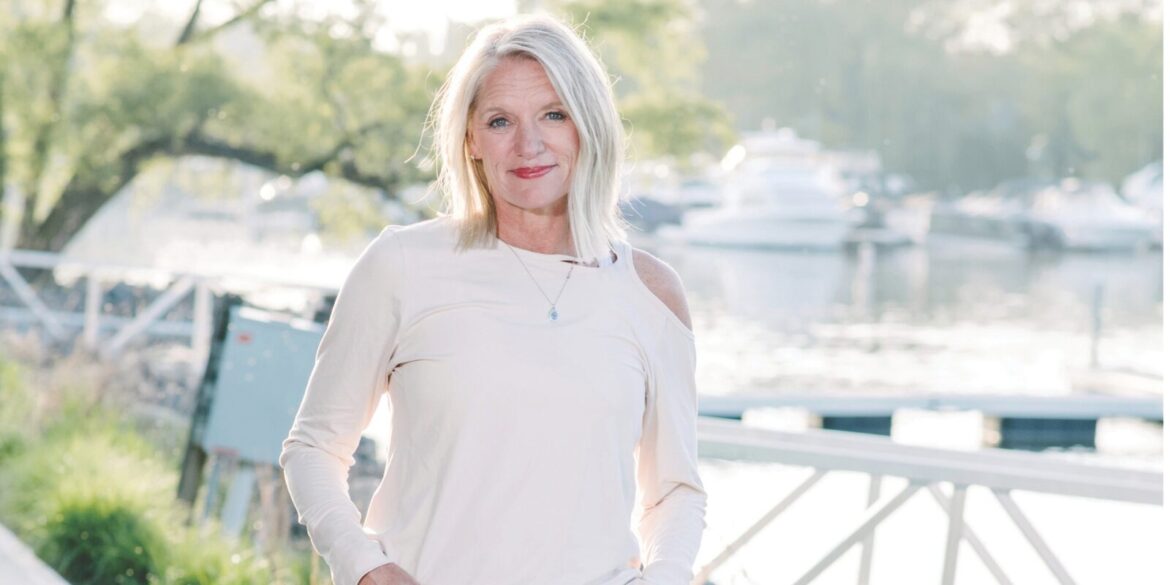
By Michelle Kullmann | Photo by Hillary Schave
In the days after Cade, my 18-year-old son, unexpectedly and tragically died from a fentanyl poisoning almost four years ago, I remember sitting with my other son, Ross, and saying to him, “I don’t know how to do this. There’s no road map for grief.”
There is no manual. No checklist. No well-lit path to follow.
I could feel the pain living in every single cell of my body, 24/7. I was afraid that I would never feel different and I’d be stuck in this deep well, living a life that felt like a prison sentence.
Thankfully, that acute stage of pain dissipated over time. Now, I have gotten to a place where I believe that living my life to the fullest is the most profound way I can honor my son.
While every person’s grief journey is unique, here are five key practices that have kept me tethered to life, love and purpose:
FIND MEANING IN THE MADNESS
After Cade died, I was filled with anger that I had never heard that “one pill can kill.” At the time, nobody was talking about the rising danger of counterfeit pills. I immediately turned my pain into advocacy. I reached out to news outlets. I told Cade’s story publicly, even when it hurt. I lobbied for law changes. I pushed to get Narcan (an opioid reversal agent) installed in all of the UW system’s dormitories. I know telling Cade’s story has saved countless lives.
I also got certified as a Grief Yoga® instructor and I host grief retreats. I believe that every action done in his honor is a thread in the tapestry of Cade’s ongoing legacy and the impact he is leaving behind in the world.
The takeaway: Finding meaning in loss doesn’t have to be something elaborate. It could be as simple as making your loved one’s favorite food, telling their favorite joke or making a donation to a charity in their name. Think about what makes you feel connected to your loved one and the ways that you can honor them.
NATURE IS HEALING
Cade loved the outdoors. He was always chasing sunsets, jumping into lakes and finding joy in the beauty of the world. After he died, I found myself drawn to the places he loved to frequent: Governor’s Island on Lake Mendota, Gibraltar Rock and Devils Lake.
Nature reminds us that everything has a cycle — and nothing lasts forever. There’s a rhythm to life and to death. As I sit in awe of trees that are hundreds of years old or mountains that have been around for millennia, I realize that our time on earth is fragile and just a blip. While I’m here for such a short time, I want to make the very most of it.
The takeaway: When I watch a sunset now, I do it for both of us. I carry Cade with me in those quiet moments. When I connect with nature, the more grounded I feel — even in my grief.
THE POWER OF COMMUNITY
Grief is a lonely road. Just as our relationship with our loved one is unique, so is our grief journey. And yet, community is one of the most essential elements of healing.
Early on, I found a group of moms who had also lost their children to fentanyl poisoning. They didn’t try to “fix” me — they understood. I also leaned heavily on my friends and faith community. They brought meals, sat with me, listened to me, prayed for me and reminded me that I wasn’t alone.
The takeaway: Grief doesn’t want to be solved. It doesn’t need to be fixed. It wants to be witnessed. Seen. Held. We need to be surrounded by those who remind us that, while the pain is uniquely ours, we don’t have to carry it alone.
BELIEVE IN SOMETHING BIGGER
When Cade died, I was reading a book on near-death experiences. I am a Christian, and believe in God and in his promise of eternal life. Reading modern-day stories about visits to heavenly realms comforts me in my belief that our consciousness continues after bodily death. My knowledge that Cade’s spirit is still with me — just in a different form — has been a lifeline. It allows me to maintain a relationship with Cade in spirit, talk to him and look for signs.
The takeaway: When I raise my vibrational energy by focusing on higher-level emotions, such as love, gratitude and joy, I feel closer to him and he shows up in dreams more often. So, I work to stay in those higher emotional states — not because the grief is gone, but because I want to feel Cade’s presence.
RELEASE PAIN FROM THE BODY
In those early weeks and months of grief, my nervous system was completely dysregulated. I couldn’t sleep. I’ve since learned that my nervous system was stuck in the sympathetic survival state of fight, flight or freeze, and that if it remained dysregulated, it could have led to chronic health conditions.
My long-time yoga practice and finding Grief Yoga® have been essential in my healing journey. In a Grief Yoga® class, gentle movement, breath, sound and meditative flows are used to express sorrow, and release pain and suffering, which helps to regulate the nervous system. Space is then created to connect with love, empowerment and emotional liberation.
The takeaway: Find soul-nurturing practices that best support your emotional wellness. When the nervous system is regulated, and in a state of rest and digest (parasympathetic state), we are better able to open our hearts to our healing journey, and start transforming our pain into purpose, love and meaning.
Michelle Kullmann is a 2022 BRAVA Woman to Watch, bereaved mother, Grief Yoga® instructor and certified grief educator.