Photographed by Hilary Schave
Just as some species of plants are reborn only through fire, so too do we humans often sprout anew after enduring a setback—even a life-threatening one. We asked three local women to share their life lessons, often learned through their own personal crucible.
They are lessons that many of us can relate to and learn from as we make our way through this world that isn’t always easy, but is guaranteed to keep us evolving.
Diana Knott’s silver linings
By Hywania Thompson
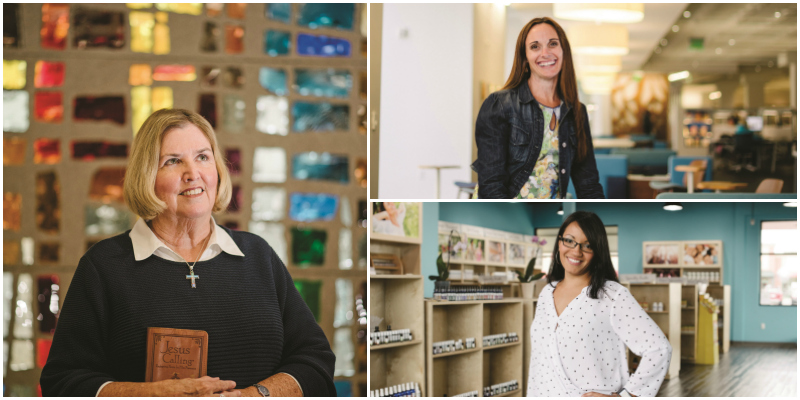
Diana Knott came to Wisconsin from Colombia with two suitcases and a desire to learn English. It was the most difficult year of her life—a tough living situation, illness and the death of her grandparents. A string of unfortunate events is enough to break anyone, but Knott relied on her faith and learned the importance of community.
Knott received her bachelor’s degree in psychology in Colombia and began working in human resources. She wanted to stretch herself and learn another language. Her boss told her about a one-year exchange program. “I had a good job in Colombia, so my plan was to come [to the United States], study for that year and go back,” Knott says. Knott’s boss supported her and promised her a job when she returned home.
Knott entered the exchange program in August 2008 and was placed with a family in Wisconsin, where she took care of the children and went to school. The living situation didn’t turn out as planned. At the same time, Knott became ill. She says God provided “angels” to take care of and support her. In the process, Knott learned just how important community is. “It’s OK to ask for help and be humble enough to receive help,” she says. “You can’t do life alone.”
Over the next several months, Knott’s struggles persisted, but she also met her future husband, David, through a bible study group at church. They continued to date when Knott moved to Michigan to complete the exchange program. Her grandfather passed away that December. Knott says she couldn’t attend his funeral because she didn’t have the money to go home. In April, she and David traveled to Colombia to visit her family, and he proposed. Shortly after that trip, Knott’s grandmother passed away but she wasn’t able to return to Colombia for the funeral.
Ten years later, Knott reflects on “the hardest year” of her life and the lessons of faith, community and new beginnings. “No matter where you’re at, it’s OK to start over,” she says. Knott’s friend Kate Greer says through all the challenges and stresses Knott has faced, she remains strong in her resolve that God can work all things out. “She doesn’t just give up when things are tough but reaches out and finds support from friends and people in the community and does what she can to rise above,” says Greer. “She is teachable and always seeks to learn more about what she is doing and reaching for.”
Knott and her husband now own Embrace Wellness in Middleton, which opened last year. The store was affected by the flooding this past August. Knott says it was a difficult time for their business, but the community stepped up and helped them clean the store, as well as supplying meals and buying them gift cards.
Knott says her first year in the U.S. was the worst of her life, but God turned it into the best thing that could happen. “Sometimes we don’t understand what we’re going through. You go through a really hard time but something happens and you’re like, OK, now I’m seeing the light.”
Laura Jean Baker’s roadmap to forging on
By Rachel Werner
Mental health issues and a chaotic home life plagued UW-Oshkosh English professor Laura Jean Baker’s childhood. “Over the years, what’s helped me most to cope with my depression is eliminating the fear factor,” she reveals. “Instead of panicking when stricken with deep malaise or a wave of sadness, I try to play life detective, figuring out which triggers might be exacerbating my negative feelings or physical exhaustion.”
A native of the town where she teaches and resides, Baker has spent a significant portion of the past decade reflecting upon the impact of the past on her present, especially since becoming a mother herself. Her recently published memoir “The Motherhood Affidavits” explores the tenable connection between addiction and crime—and the realization that she often has more in common with her husband’s criminal defense clients than one would guess.
“A lot of judgment ends up surrounding people in ‘the system,’ but Ryan and I have the same origins as many of them. Our lives ended up taking different paths because we had access to resources and education, plus each other to rely on,” she explains. “Addiction is usually a way of suppressing pain and a lot of pain comes out of poverty and unstable beginnings.”
Baker’s spouse, Ryan Ulrich, agrees that his clients often are trapped in desperate cyclical patterns. “Many of the people I represent have broken the law to support their habits or blunt the edge of their anxiety,” he says. “Without drugs and alcohol, I would be practicing a different type of law.”
Baker and Ulrich are candid about the financial struggles they’ve faced over the years while scraping by as undergraduate and grad students, then again in the years that followed as their family rapidly grew. The hormones of pregnancy and the initial postpartum period led Baker to crave more offspring as a way to ward off the undiagnosed, chronic depression she’s been grappling with since adolescence.
“I saw it last in myself,” she reveals. The couple has five children.
Part of banishing the stigma of her own struggles has been giving herself permission to be less of a perfectionist, yet more intentional in terms of response to the chemical and hormonal fluctuations she experiences. “As a writer whenever I sit down to write, it’s to actively produce in a way that works for me. When I teach, everything I do is either to build community, confidence or skills,” she shares. “The idea that we’re ‘supposed’ to be doing other things is actually counter-productive. We have to honor the ways in which our brains naturally function.”
Kathy Collins had a brush with death, and it changed her life
By Emily Leas
It’s rare to meet a person whose eyes sparkle with light, inviting a connection. But that’s the first impression upon meeting Kathy Collins, a woman who wanted nothing more than to be a nun growing up and now finds herself on a journey as a mystic, a chaplain and a writer.
Raised in Port Washington, Wisconsin, Collins’ father insisted she “live her life” before entering the convent. So she did. She got married, had a son, divorced and put herself through the grind of corporate life. Then breast cancer brought her world to a screeching halt, and a new season of her journey began.
She started chemotherapy but her body weakened so badly after just two treatments she landed in the emergency room teetering between life and death. She recovered just enough to leave the hospital but was bedridden for six months while continuing chemotherapy.
“During this time, I learned the quietness that was speaking to me. An awareness came in,” Collins says.
That awareness allowed her to evaluate her faith, question the visions she was having of herself in a past life and embrace the connections with her brother who had died as an infant. She began to wonder if these were just coincidences, or if we are all connected somehow.
While she was bedridden in what Collins calls her “cell,” she watched the tree outside her window lose weak branches in winter and spring winds so it could grow new, healthy, strong branches.
“I, too, realized I had to let some weak branches go in my life so I could grow.”
Collins dropped the material things and fast-paced job and moved to Sun Prairie to take care of her aging parents. By slowing down, she says her world opened up.
She began to connect and understand her experiences and visions the universe was showing her and realized that all signs pointed to becoming a chaplain. Trusting her instincts, she applied to the chaplain program at Meriter Hospital in 2015 and was accepted that same year.
This example is something that Liz Awe, Collins’ friend and the wife of her cousin, has learned from Collins over the last few years.
“She trusts her gut feeling. So many of us aren’t in the habit of doing that. That inner sense is very important to believe in. If you feel it’s right for you, go with it,” says Awe.
As Collins started her chaplain training program, her mom had a serious fall. She recalls the 90 minutes at the end when her mother’s eyes cleared. She held her mom’s hand and poured her love, memories and appreciation out. As tears trickled down her mother’s cheeks, Collins kissed them away and watched her pass peacefully to the other side.
Now when she works with families to transition a loved one from life to death, she encourages them to talk directly to their loved one and it becomes a peaceful, joyous occasion.
Wanting to share her story and the lessons she learned, Collins re-read years of journals and started to see how all her experiences fit together. She decided to write a book to share her message of compassion and synchronicity. She published “The Mystic Chaplain” in 2018 and has spent much of the year sharing her story at book signings in the area.
She closes her book by saying her journey is not finished, but instead this is just another season in her life. Her weak branches will continue to break away as the seasons change so she can continue to grow.